ALTERED WORDSIndependent publishing house
Available

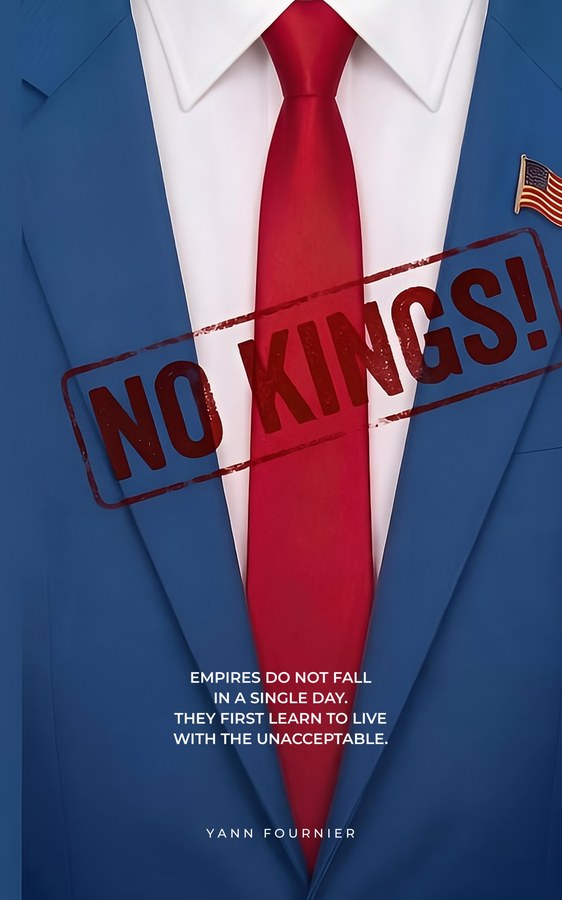
NO KINGS!

Chronicles of a Collapse, 2024–2026
Order
NO KINGS!

EMPIRES DO NOT FALL IN A SINGLE DAY.
THEY FIRST LEARN TO LIVE WITH THE UNACCEPTABLE.

November 2024. A dozen eggs cost nine dollars in Michigan. Donald Trump has just been reelected, promising to bring prices down.

This could be the beginning of a chronicle about the price of eggs. In reality, it is the beginning of a much broader story.

Because there is something strange about our time: we live surrounded by information, and yet we have never been so vulnerable to the narratives that replace it.

We know everything. Immediately. All the time. A war breaks out thousands of miles away, and seconds later we are watching it. A president says something, and before he has even finished his sentence, it has been cut up, commented on, distorted, and transformed into thousands of competing versions. A rumor appears in Tokyo and can become a certainty in New York before breakfast. A photograph can be real, manipulated, or generated by a machine. A statement can be true and still be misleading. A lie can contain enough truth to become believable.

We have entered an age in which the problem is no longer simply knowing what is true.

The problem is knowing whether we are still capable of recognizing it.

This is the phenomenon Yann Fournier calls Infosclerosis.

It is not a lack of information. It is exactly the opposite. A continuous accumulation of facts, images, comments, notifications, outrage, propaganda, analysis, counter-analysis, and falsehoods eventually produces a strange side effect: the brain stops sorting. It no longer necessarily searches for reality. It searches for what confirms us, shocks us, reassures us, entertains us, or resembles us.

By knowing everything, we risk understanding nothing.

NO KINGS! was born from this concern.

Since the November 2024 election, Yann Fournier has written, week after week, at the pace of events, without waiting for History to finish its work before beginning his own. Signalgate. Wars. Iran. American institutions. Political purges. Presidential pardons. Financial interests. The Epstein files. The struggles over power. The demonstrations. The fractures within a society that sometimes seems unable to decide whether it is witnessing a democratic crisis, a cultural revolution, or simply one gigantic reality show whose final episode no one has written yet.

These chronicles were not written from the comfort of hindsight.

They were written in the noise.

That is an essential difference.

History, once it is over, possesses a deceptive elegance. We know the dates. We know the winners. We know the consequences. We can reconstruct a logic. Everything seems to have naturally led to what happened.

But when events are actually unfolding, nothing is clear.

Information arrives out of order. Versions collide. Certainties change from hour to hour. Actors sometimes lie, often make mistakes, and almost always improvise. Markets react to rumors. Governments deny what social media claims. Media outlets correct their own reporting. And everyone has to try to understand the world while the ground beneath them keeps moving.

It is in this unstable space that these fifty-two chronicles were written, between November 2024 and April 2026.

They are less a history of those eighteen months than a collection of X-rays taken while the political body was still moving.

The apparent subject is America.

The real subject is much broader.

It is our relationship with power.
Our relationship with truth.
Our relationship with images.
Our relationship with one another.

And perhaps, above all, our relationship with ourselves.

Because Donald Trump is not the true subject of this book.

He is the revealer.

Trump is interesting not only because of what he says, what he does, or the controversies he provokes, but because he reveals something that extends far beyond his own person: the contemporary power of political narrative. He shows what happens when a political figure simultaneously becomes a politician, a brand, a spectacle, an object of hatred, an object of devotion, and a machine for producing attention.

It is no longer enough to govern.

You have to occupy mental space.

Power is no longer measured solely by the number of laws you pass or the number of soldiers you command. It is also measured by your ability to monopolize attention, to define the subjects everyone is talking about, and sometimes even to determine the emotions those subjects are supposed to provoke.

Power is no longer simply about telling people what to think.

It is about deciding what they will think about.

And while they are watching, reality continues to work in the shadows.

Perhaps that is where Infosclerosis begins.

One piece of information drives out another. One catastrophe replaces another catastrophe. One outrage erases the previous one. We barely have time to understand an event before a new scandal demands our attention. The brain becomes a waiting room in which every piece of information has a priority ticket.

So we consume.

We no longer always read in order to understand. We read in order to react.
We no longer necessarily seek the truth. We seek a position.
We no longer ask, "Is it true?"
We ask, "Whose side are you on?"

That is a profound transformation.

Because a democracy cannot function for long if its citizens no longer merely have different opinions, but different realities.

When everyone has their own facts, political debate gradually ceases to be a confrontation of ideas and becomes a war of perceptions.

And in that war, the most dangerous person may not be the one who lies best.

It may be the one who manages to convince us that nothing is true anymore.

Because a citizen who believes a lie can still be convinced.

A citizen who no longer believes in anything becomes much easier to manipulate.

That is why NO KINGS! is not a book about Donald Trump.

Nor is it a book attempting to provide yet another summary of American current events. Newspapers, news networks, and social media already produce enough timelines to fill several libraries.

This book is looking for something else.

A framework for reading.

An attempt to look at events not only in terms of what they tell us, but in terms of what they reveal.

What happens to a democracy when narrative matters more than fact?
What happens to a society when outrage becomes a form of entertainment?
What happens to truth when it has to compete with millions of images produced every day?
What happens to our freedom when our attention has become the most valuable commodity in the world?

And above all: what happens to the individual when they no longer know whether they believe something because they actually believe it, or because they have been told often enough that they are supposed to believe it?

This is where the author's personal experience meets the subject of the book.

Trained as an economist and an entrepreneur, having worked across four continents and in very different professional, economic, and cultural environments, Yann Fournier does not observe politics as a specialist confined to a single discipline. His perspective comes as much from economics and the mechanisms of power as from the experience of someone who has spent much of his life between different worlds.

That outside position matters.

Because living between cultures teaches you something quite simple: what we call "normal" is often simply what we are accustomed to.

Societies have their own mythologies. They possess their sacred words, their taboos, their heroes, their enemies, their founding narratives, and their contradictions that everyone eventually stops seeing.

Moving from one country, environment, or perspective to another sometimes allows you to see the seams.

It is in those seams that Yann Fournier looks.

He does not claim to stand above the chaos.

He writes from within it.

With his own biases, his own anger, his own mistakes, and his own uncertainties.

Because that may be the only honest position in an age when everyone claims to possess the truth seconds after reading a headline.

NO KINGS! brings together fifty-two chronicles written between November 2024 and April 2026, culminating in the demonstrations of April 12, 2026, when millions of Americans took to the streets behind a slogan of almost primitive simplicity: NO KINGS!

No program.
No candidate.
No doctrine.

Two words.

A refusal.

And perhaps that is ultimately what best sums up this book.

Refusing to let narratives think for us.
Refusing to confuse noise with information.
Refusing to mistake repetition for truth.
Refusing to consider the unacceptable normal simply because it has become routine.

Refusing kings, but also the little kings we create every day with our clicks, our fears, our certainties, and our attention.

Because the real subject of this book is not who occupies the White House.

The real subject is what happens inside our heads when a narrative becomes powerful enough to take the place of reality.

And perhaps Infosclerosis begins exactly there: the moment we stop asking whether what we believe is true.

Then we are no longer merely spectators of History.

We become its material.

And the chaos can begin.

Every claim in these chronicles rests on a verifiable source. The complete apparatus — more than eight hundred references, organised chronicle by chronicle — is available online.

View the sources